
1. The author of this article (Marriott) was a young social anthropologist when he conducted this research in the 1950’s. He writes about being cognizant of following recommended anthropological techniques, including participant observation. He humorously describes a problem with this approach that limits his ability to describe the Holi ritual accurately. Describe this problem and explain how he solved this problem the next time he took part in the festival. (5 pts)
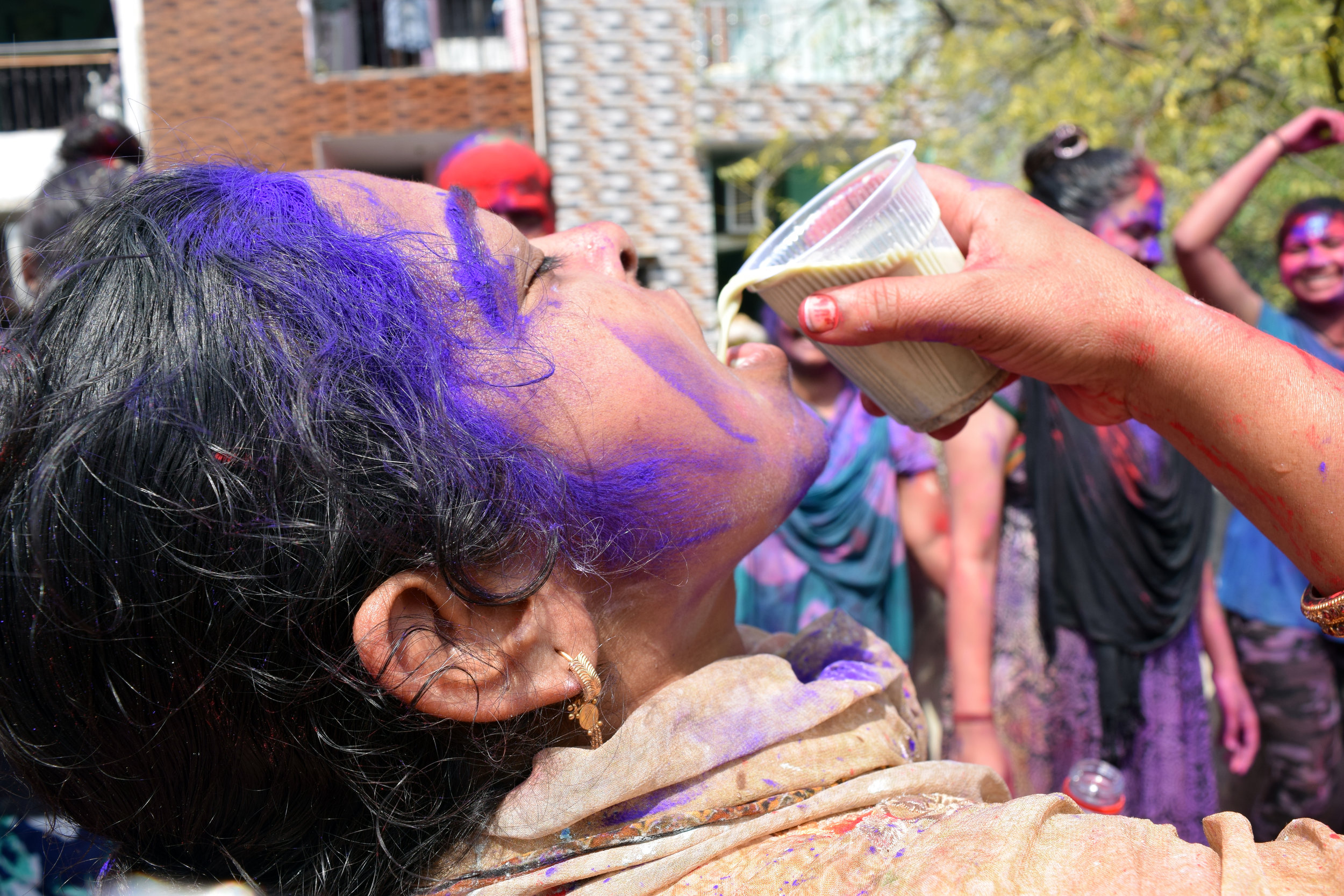 |
| Drinking bhang |
Marriott was a young anthropologist and still very conscious of the lessons he had learned in graduate school, including those about the importance of participant observation. He was eager to do anthropology the “right way”, and so dove into the Holi Festival fully. When his landlord offered him a drink called “bhang”, of unknown origin and content, he duly drank it. Only later did he learn it is a traditional cannabis-infused drink, which effectively incapacitated him for the duration of the festival. He still took part, but remembering and recording events were impossible. He was left with hazy recollections of what he experienced and his “notes” were nothing but illegible scribbles. The following year, he wisely abstained from the drink so that he could accurately record the festival. Participant observation does carry risks! Marriott was lucky to survive this experience intact. While it makes for a funny story, anthropologists do need to balance the need for the full “emic” experience with the necessity of personal safety.
2. The author describes certain individuals who are effectively targets of the ritual festivities, i.e., those who may experience the ritual negatively. Who were the targets of the Holi celebration? (And note that the author identifies himself as one of the targets.) Explain some of these negative experiences. (5 pts)
 |
| Women beating men with sticks |
The targets of this festival ranged across the spectrum of economics, education, social status and gender, but Marriott eventually noticed that they all had one thing in common. All targets were in some position of power in the community, either through their wealth, their caste, their role in the community (like landlords or employers), their education and (in Marriot’s case) annoying outsiders who pestered people with questions. Targets experienced any number of assaults, including being harassed in their homes, pelted with mud and water mixed with cow dung, sprayed with buffalo urine and beaten with canes.
3. According to the author, who is benefiting from this ritual? Does it produce a change in the culture, even temporarily? (5 pts)

There are actually two different answers to this issue of “benefit”, short term and long term:
Short term: During the festival itself, those who were the “attackers” received the benefit. They were those of lower power in the community, often women, young people, and those of lower status/caste. They had one day where all slights and humiliations incurred upon them by those in power could receive retribution without retaliation. They were free to express their suppressed anger and frustration on those who they felt harmed them in some way through their power. For one day, they could “flip” conditions and hold that power over others. That is the temporary change this ritual produces, namely altering the power structure of this population.
Long Term: But I suggest those in power ALSO benefit in the long term. Anger and frustration from a much larger lower power population can cause harm if left to simmer until it explodes in rebellion. The Holi Festival offers those with less power the opportunity vent that frustration in socially acceptable (and less harmful way) once a year. Those who do not have the power, get to express their frustration with their circumstances and anger at slights (perceived and real) in a way that won't threaten their future in the community. Then, as many students pointed out, everything goes back to “normal”. That translates to a return to the “normal” power structure, which includes businesses running as normal and those in power retaining it in the community, continuing to run their businesses and direct the population from the wealthy, ruling class.
4. Given your answers in the last two sections, can you explain the function of this traditional ritual in relation to the strict social caste system? (10 pts)

This ritual has a "pressure valve" function. Remember that those in the lower classes/castes (i.e., the "masses", to use Marx's term) will feel frustration with their circumstances and perhaps anger with those who have power over them due to imagined or real slights. Let this frustration simmer too long and you have revolt and rebellion. This ritual allows that pressure to be released in a socially acceptable way to maintain social stability. This benefits the entire community, as no one benefits from instability, which negatively impacts the economy, harming workers and employers alike, though it must be recognized that those in power probably benefit more in terms of wealth acquisition. The “threat” or potential abuse during the festival may actually push those in power to watch their own behavior towards those of low power with the recognition that being targeted during the festival is not pleasant, to put it mildly.
5. Do you think the modern "Festival of Colors" form of this Holi ritual serves the same function as the traditional form described in the "Festival of Love" article? (5 pts)

No, the “Westernized” version of Holi CAN’T have the same function. The "release valve" function disappears when you have unconnected people from different communities taking part in this festival. There is no measure of status at the modern festivals. You don't have the known powerful surrounded by those over whom they have power. So there is no socially acceptable reason to go around whacking people with sticks and dumping urine on them. :-) That said, it likely functions to bring larger communities together and the businesses in the area probably benefit financially from supporting it.
6. Identify a cultural ritual that interests you (outside of your own culture) and introduce your readers to this culture. (25 pts total)

There are
many examples rituals, so I won’t go into that lengthy list here. I encourage you to go back and read more of
other student posts as there are many interesting descriptions (see one unique one above).
One caution… many students tend to take modern descriptions of these festivals at face value and
try to find the function of the ritual from that. But as we see in the example of Holi, the “modern”
versions can be disconnected from the function of the traditional versions.
That means we must dig into the origin and history of these rituals to
understand their function in a population.
That is what Marriott’s article offers us with regard to the Holi
festival. It is a first-hand experience
of how the Holi festival is practiced in the culture where it originated. That is the only way to grasp both the “emic”
and the “etic” description of this ritual and have the tools we need to discern
the function it serves historically in that culture.


No comments:
Post a Comment