
 |
| 1983 Israeli-Lebanon Peace Treaty that collapsed a year later. |
The Arab-Israeli conflict is a regular part of our news
cycle and has been for decades. The
conflict occurring in the Middle East between Israel and its Islamic neighbors
has been ongoing since long before the UN partition plan for Palestine and the
declaration of the State of Israel on May 14, 1948, but that event certainly
intensified the conflict.
Even as a college student, I was aware of it but not knowledgeable. It seemed to me that leaders would step in to
try to solve the conflict, there would be a short period of hope, and then the
conflict would arise again. With my
focus on school and family and life in general, I didn’t take a deep dive into
trying to grasp what was happening there.
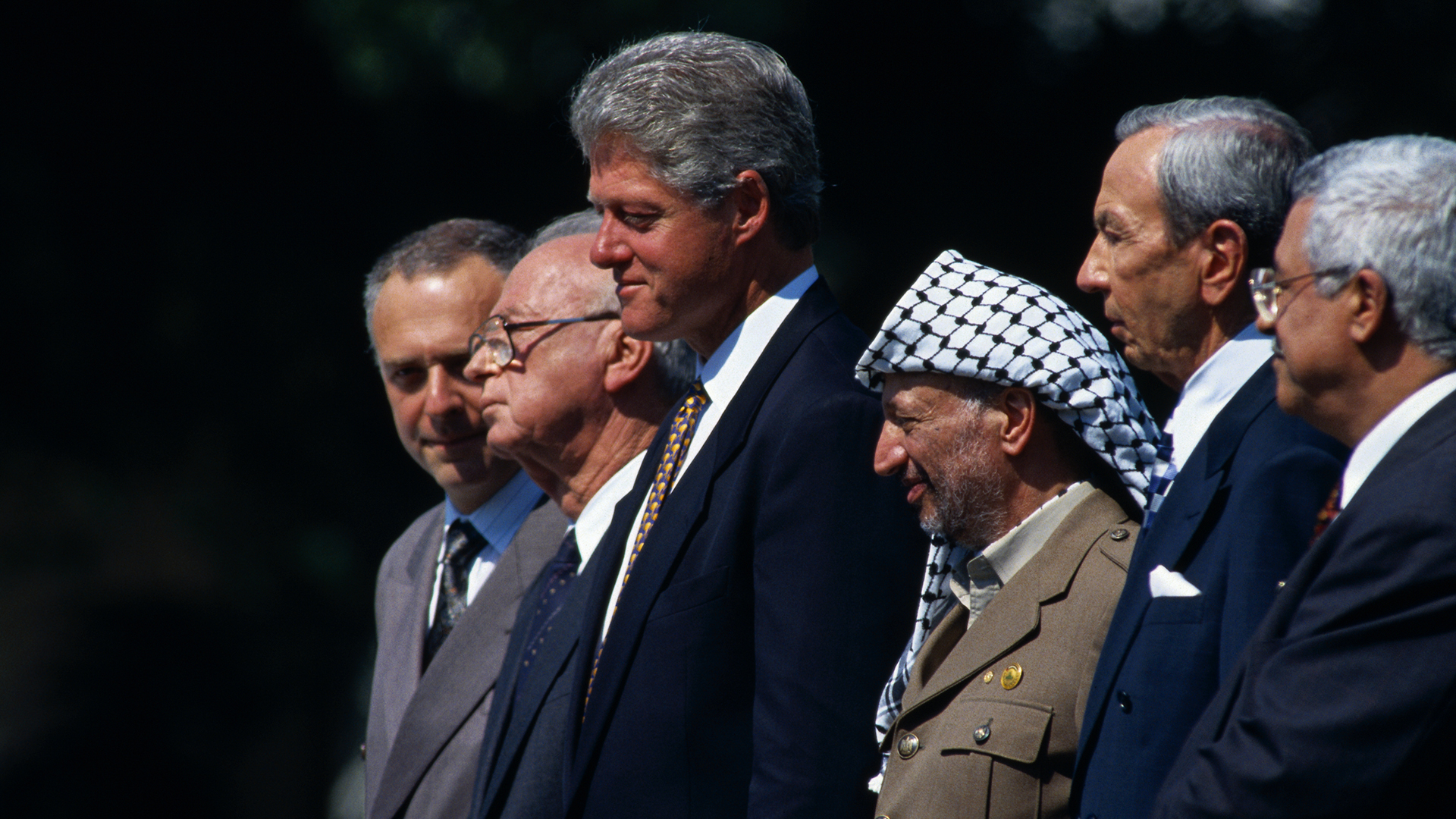 |
| The Oslo Accord of 1993 |
A few years later, I picked up (just on a lark) Thomas Friedman’s book “From Beirut to Jerusalem” in the hopes that it might offer some insight into events there. The book covers the span of time when Friedman lived and worked in Beirut, Lebanon and Israel and also covered some history of the region to lay the foundation for the book.

The book was fascinating but also depressing, as I walked away from it with a far better understanding of the source of the ongoing conflict but also the impression that the differences that were creating this conflict were seemingly insurmountable. I could not envision a solution that would bring about peace.
I remain hopeful that future generations might prove me wrong, and would argue that cultural anthropologists could play an important role in successfully bringing about a peaceful solution to this longstanding conflict. That’s where you come in!
But first some background: There are some key issues that I suggest make a solution extremely difficult to generate, and surprisingly, it has less to do with a conflict between the two faiths (Judaism and Islam) and more to do with other factors.
1. The “Tribal” Nature of Traditional Islamic Populations: Friedman does a great job of explaining the difference between the two primary sects of Islam, namely the Sunni and Shia. The split between these two groups is traced back to 632 AD with the death of the Prophet Muhammad. Sunnis argued that leadership should be elected. Shia favored leadership remaining within the descendants of Muhammad. The two groups generally share most beliefs and practices of Islam, but this disagreement in determining leadership almost 1400 years ago produced this significant split within Islam that remains today.

The result? A highly diverse population in practices and beliefs. That by itself is not a bad thing… unless a situation arises where it might be to their advantage to increase their power by speaking with one voice.
So, the problem:
- On one side you have a large decentralized population of tribal
units (even if they are cobbled together into countries with central governments) that do share a generally common faith (Islam) but who have their own unique
priorities and goals for their people. They may actually have conflict between
these tribes stemming from ongoing competition for resources in a dry climate
but also from historical religious differences (Sunni and Shia). Some populations have positive relationships
with other non-Islamic countries. Others do not.
- On the other side, you have a centralized state government that is predominantly Jewish, well-organized and well-funded, who has established connections with other powerful and well-funded governments.
Can you see how resolving the conflict between these two populations might be nearly impossible due to their inability to speak the same “language”, with the recognition that this could apply to their linguistic language but also their cultural language, their religious language, and their geopolitical language? You have two populations that differ in so many different ways (Jewish vs. Islam, Hebrew vs. multiple language bases, tribal vs. state governments, Jewish culture vs. multiple cultures arising from nomadic pastoral Islamic histories), it should not be a surprise that they cannot find enough commonalities to find a way to work towards a mutually beneficial peace process.
This is where I think anthropologists (using applied anthropology) could help. You cannot solve problems by ignoring differences. You need to acknowledge those differences, understand them, and then work to find shared cultural goals that could lead to a peaceful solution.
So here’s your prompt for this discussion:
Imagine that you are a cultural anthropologist who is part of a team analyzing this Arab-Israel Conflict in search of a solution. As an anthropologist, you are putting your own beliefs and biases aside to the best of your ability. You have two options for a response:
1. Do you see a
possible path forward in this conflict that could allow these two diverse
populations to talk to each other in spite of their differences? There is no time limitation on this and you
have free range to imagine any solution, even if it involves a long-term change
in governance or political relationships.
The only restriction is that the solution must be in the realm of the
real world, i.e., no “magic” or “miracles”.
2. Perhaps you don’t see a path forward for a peaceful solution. Explain why you think the conditions of this conflict bar a possible solution to this conflict from a cultural anthropological perspective.
I recognize that this may be an impossible situation and I’m asking you to consider a solution to a problem global governments have not been able to solve. But you have the freedom to think outside the box on this. Stretch your brain a bit for this discussion. Your initial comment is worth 10 pts (different from prior discussions) and a critical response to another student is worth 5 additional points.


I choose Option 1: I do see a path forward, but only if we stop relying on huge, top-down treaties and start building peace from the ground up using local cultural traditions.
ReplyDeleteTraditional peace attempts often fail because they try to force a single state agreement between two very different groups: a centralized, unified government on one side, and a diverse population made up of different local, regional, and historical tribal communities (such as Sunni, Shia, and Bedouin groups) on the other. Forcing them to speak the same political language right away hasn't worked.
Here is how an applied anthropology approach could create a realistic, step-by-step path to peace:
Focus on Local Community Leadership: Instead of trying to make one giant deal between central governments, negotiations should start locally. Anthropologists can help organize direct agreements between local city councils and traditional Arab, Bedouin, or Palestinian community elders. Building trust locally respects traditional leadership instead of forcing a one-size-fits-all plan.
Work Together on Survival Needs (Water and Land): Ideological and religious arguments usually lead to deadlocks. However, both groups live in a dry environment with limited resources. By focusing on practical, everyday needs—like joint water management and shared farming projects—both communities gain a non-political reason to talk and cooperate every day.
Move Toward Regional, Local Governance: Trying to centralize all power creates a constant struggle over who controls what. A better long-term political model would be a loose regional federation. This would let individual cultural, religious, and local groups manage their own schools, local laws, and cultural practices, while sharing regional security and natural resources.
Real peace won't happen overnight with a single document. By starting small at the community level, focusing on practical survival needs like water, and respecting local traditions, a realistic path toward living peacefully side by side is possible.
Hi Shahab! Your post offers a really thoughtful and practical approach by focusing on local leadership, shared survival needs like water, and decentralized governance rather than traditional top-down treaties. It makes a lot of sense from an applied anthropology perspective to build trust from the ground up, especially when dealing with diverse local communities that have vastly different cultural and structural backgrounds.
DeleteI liked your concept of making peace bottom-up and not depending on agreements by big government parties. It is good especially the part about cooperating on common needs such as land and water since it would definitely help to build trust as they affect people in their daily lives. The idea that communities would have more power is also quite an interesting one since it would give cultures and religions the chance to keep their customs while still cooperating with each other.
DeleteGood answer. Well explained. I agree with the idea that this has to really start at the community level. It is commonly said that "all politics is local". But it is hard to do community outreach and informational drives with bombs flying, unfortunately.
DeleteFrom an anthropological standpoint, especially coming from an Egyptian background where the reality of this conflict is felt so closely, the root of the problem isn't just a simple misunderstanding between two different religions. Instead, the deepest barrier to peace is the ongoing injustice of land displacement. When the State of Israel was established, it created a massive imbalance: you have a highly organized, centralized government with backing from global powers on one side, and a historically displaced, fragmented population on the other whose lands were taken. From a cultural and structural perspective, expecting people to just sit down and compromise when they are dealing with stolen land, statelessness, and deep systemic oppression is why traditional peace talks always collapse.
ReplyDeleteIf we are looking for a real-world path forward that actually addresses these cultural and structural gaps, we have to throw out the old playbook of superficial treaties that ignore justice. A true solution can't just be about managing an unequal status quo; it has to start with acknowledging the historical reality of displacement and moving toward total decolonization. Practically speaking, this points away from the failed "two-state" model and toward a radically different framework such as a single, shared democratic state stretching from the river to the sea where everyone, regardless of background, has equal rights, citizenship, and the right to return to their homes. Only by dismantling the structures of inequality and recognizing everyone's fundamental human dignity can we build a peace that actually lasts.
I agree that the conflict is much more complicated than just a disagreement between two religions. I think your point about displacement and inequality is important because it would be hard to expect people to trust a peace agreement if they feel their history and suffering are being ignored. I also thought your idea of a shared democratic state was interesting because it focuses on giving everyone equal rights. Even though creating something like this would be difficult because of the amount of mistrust between the groups, I think applied anthropology could help by listening to both sides and finding ways to make people feel heard, represented, and safe.
DeleteI really appreciate how you brought in an applied anthropological perspective and highlighted the core issues of land displacement, structural inequality, and statelessness. Your argument that lasting peace requires moving beyond superficial treaties to focus on equal rights, citizenship, and human dignity for everyone is very compelling.
Delete"we have to throw out the old playbook of superficial treaties that ignore justice"
DeleteAgreed. This will require thinking outside of the standard box of tricks. That's why we need young people to take part in the process. ;-)
I would choose Option 1 because I believed there is still a possible path toward peace, even though it would probably take a very long time and a lot of effort from both sides. I thought your point about the conflict being more than just a disagreement between Judaism and Islam was really interesting. There are also differences in culture, politics, history, and the way different groups view their identity. All of these things can make it harder for people's beliefs, values, traditions, and everyday experiences. Instead of assuming that everyone on one side thinks the same way, anthropologists could help show the different perspectives within each community and help people better understand why the other side feels the way they do.
ReplyDeleteI also think a good place to start would be with smaller issues that affect people's everyday lives, such as education, healthcare, water, jobs, and safety. Having people from both communities work together on these problems could create opportunities to communicate and slowly build trust. Even if they disagree about politics or religion, they may still have similar goals for their families and communities. These smaller connections could eventually make it easier to have conversations about the bigger issues. I don't think there is going to be one simple solution to conflict, but I also don't think that means peace is impossible. It may take generations for enough trust to develop, but I think listening to both sides and finding common goals is a realistic place to begin. Anthropology could help by helping people understand each other instead of only focusing on what separates them.
I really like how you highlighted the importance of starting with everyday issues like healthcare, water, and safety to build trust across communities. Your point about using anthropology to uncover diverse perspectives within each group—rather than treating either side as a monolith—is a spot-on application of the course material.
DeleteAgreeing with your argument, small everyday problems might be solved first rather than addressing large political differences. Particularly I appreciated your use of healthcare, education, water and job creation issues since these are concerns that impact all individuals, irrespective of their political views or religion. I also believe that through solving small problems, trust can be established in order to move towards solving harder problems in the future. Anthropology is the subject that makes people see each other from the point of similarity rather than differences. Thus, this branch of anthropology plays a crucial role in building peace through applied anthropology.
Delete"I also think a good place to start would be with smaller issues that affect people's everyday lives, such as education, healthcare, water, jobs, and safety."
DeleteYes, the so-called "kitchen table issues". I agree. But we need governments to stop acting like idiots first so this can happen (pardon my language).
There appears to be a way out of this conflict between Arabs and Israelis, but it must involve patience and communication as well as learning about the culture and trust-building. Using the tools of applied anthropology, one way to go about this would be by acknowledging that neither side is homogenous in its identity, experience, beliefs, or objectives. An anthropologist can facilitate the process of making sure both sides engage in communication in order to discover common objectives that are related to personal issues, including feeling safe, having economic stability, access to education, and being able to have a family without any fear of violence.
ReplyDeleteMoreover, I am convinced that a peaceful existence should occur through gradual development and not one-time agreement. Various collaborative efforts like educational exchange programs, economic development programs, and environmental protection initiatives could provide an opportunity for both populations to engage in collaboration. Through this process, anthropologists could identify cultural misunderstanding issues and help people from both sides to communicate with one another effectively. In general, my opinion about the peaceful coexistence of these two communities is positive. However, I am convinced that it can be achieved only through accepting cultural differences and not trying to ignore them. Instead of making these two populations culturally identical, the purpose of the effort should be finding common ground that enables them to live peacefully together.
I agree that peace would probably take a lot of time instead of happening through one agreement, especially because there is a lot of hurt and trauma on both sides that could be hard to recover from. I like your idea of using education and economic programs to bring people together initially and then to work on building trust. Finding things that both sides care about could help them work together and move toward peace, sort of like uniting against a common "enemy" or problem.
DeleteHey!
DeleteI agree a lot with how resolving this conflict will take gradual steps and not just flipping a switch, and I loved your idea of using anthropologists to understand and connect people. Thank you for sharing!
Hi! You're right, a peaceful existence will probably take a long time and be a multi generational effort, and that effort has to be consistent and constant for long standing peace. I think your ideas for educational programs are great, and probably one of the more realistic and effective solutions in the long run. Neither culture should have to be erased to make room for the other.
Delete"Various collaborative efforts like educational exchange programs, economic development programs, and environmental protection initiatives could provide an opportunity for both populations to engage in collaboration. "
DeleteAgreed. We are missing the boat here by trying to make this a one-on-one effort between leadership. It needs to be a global, multi-front effort. This is where the UN (a relatively neutral body) might be able to step in to help coordinate this multi-prong effort, but I think we need to stop the bombs from flying before we can do that, unfortunately.
I do think there is a possible path forward, but it would require a long period of rebuilding trust and understanding between both populations. From a cultural anthropology perspective, I think one of the biggest problems is that each side has different histories, identities, political structures, and cultural experiences that influence how they view the conflict. Because of this, simply creating a political agreement would probably not be enough to create lasting peace.
ReplyDeleteI think cultural anthropologists could help by working directly with communities on both sides instead of only focusing on political leaders. This could include creating opportunities for Israeli and Palestinian civilians to communicate, share personal experiences, and better understand how the conflict has affected each other. Education could also play a major role by teaching younger generations about both perspectives instead of presenting only one version of the conflict.
There would also need to be compromises involving safety, political representation, land, and access to resources. These changes would probably take generations because distrust has developed over such a long period of time. I do not think cultural differences need to disappear for peace to happen. Instead, both populations would need to recognize those differences while also finding shared goals such as safety, stability, family, and a better future for their children. Anthropology could help identify those common values and use them as a foundation for communication and eventually a more peaceful relationship.
Hey Aliyah,
DeleteI agree completely with everything that you said, I think education for the younger generations in order to ensure a better future and end their conflict is an amazing idea. Loved reading your post thank you!
Hi Aliyah, I love what you said about the civilians communicating and connecting personally, because hearing other people's perspectives and experiences in a environment that enables those conversations makes empathizing with the "other" group much easier and that empathy helps talk about things like peaceful resolutions.
DeleteAll good points. Yes, this needs to be a multi-prong effort, occurring at the community level to have it be an organic process with "sticking power". I also agree we need to do what we can to eradicate that "them vs. us" mentality and see all from a humanist perspective with common goals. We all need basic things: Food, shelter, water, health care, education for our children. If we can speak from these commonalities instead of our differences, that would be a good place to start.
DeleteI think there is a possible path forward to bring this long going conflict to an end. Of course it would need a lot of understanding and trust between the two which is why it seems so impossible for this resolution to happen. Especially because of how deep this conflict has been going on for. I do think they have a lot of commonality that would make more sense for them to be united than conflicting like this for so long.
ReplyDeleteI do recognize their differences and understand how it will be so much harder it will be to actually change than just write down a solution that sounds perfect on paper. But I do believe they will hopefully, eventually come to an agreement that both political parties will come to.
A lot of changes would have to be made and agreed upon to see actual changes but I think if both sides had the same education, environment standards, and really just everyday resources that could be a good start to change.
Anthropology can also partake a good portion of understanding and education to help this conflict. Accepting each others differences and values and all in all respecting each other to really see all the unnecessary damage that’s been going on.
"A lot of changes would have to be made and agreed upon to see actual changes but I think if both sides had the same education, environment standards, and really just everyday resources that could be a good start to change."
DeleteAgreed. But how do we even get there?
I think that there is a possible way forward in the Arab-Israeli conflict, but it would take a long time, lot of cooperation, and would probably need to have multiple generations growing up without the conflict. From an anthropology perspective, I think the first step would be for both sides to focus on things they have in common, such as wanting their families to be safe, having a home, having jobs, and giving their children a good future. This would also require them to decide if these things they want in common for the betterment of their people is enough to attempt to fix the conflict.
ReplyDeleteAnthropologists could help by bringing Israeli and Palestinian people together to talk and learn about each other's lives. This could include families, religious leaders, community leaders, and young people. By shifting the focus from the politics of it all, it humanizes both sides instead of villainizing them into just "the enemy". The goal would not be to force everyone into agreement with each other, but instead, it would be to help each side understand the other person's experiences and concerns.
I also think that a peaceful solution would need to deal with the major issues at hand here like land, safety, and political rights. A two-state solution could still be possible if both sides had strong protections, but were also willing to work together. Another potential option could be some type of shared government or system where both groups could keep their own cultures while working together on the shared issues such as water, trade, and security.
"would probably need to have multiple generations growing up without the conflict"
DeleteUnfortunately, you are probably right here.
In a way, this conflict has parallels with the climate change crisis. Even if we start *right now*, and somehow stop actions that create setbacks (e.g., bombing and attacks) of all kinds), this will likely take generations to fix.
ReplyDeleteIf I were an anthropologist trying to help with this, the first thing to think about is the idea that peace requires everyone to agree on politics, religion, or government first. What I'd look for instead is what people on both sides actually care about in their day-to-day lives, underneath all the bigger political and religious stuff.
I think the mistake a lot of official peace talks make is treating this like two governments negotiating a deal with one side being a unified state (Israel) and the other side being treated like it's one unified group too, even though it's actually a patchwork of very different tribes and communities with their own leaders, priorities, and even disagreements among themselves. That's like trying to have one conversation with a hundred different people who don't all agree with each other. It's not going to last.
So instead of starting at the top with the top authorities like presidents, prime ministers and writing treaties, I think it makes more sense to start small, community by community. Talk to actual local leaders about the things that affect their lives right now: water, land, safety, jobs. Those are things people on both sides care about regardless of religion or politics. A herding community and a neighboring farming community might have more in common with each other, practically speaking, than either does with their own government's official political stance. Building trust at that local level, one relationship at a time, seems a lot more realistic than expecting one big agreement to fix everything overnight. it wouldn't guarantee peace, but I think if enough small, local relationships build up trust over time, it will create a unity that treaties can't.
" I think it makes more sense to start small, community by community."
DeleteMany students have highlighted this important point, and I agree. We need to find commonalities at the human level, not the government level (which doesn't really exist), and work from there.
All good comments. Some thoughts.
ReplyDeleteMany suggested that we need to approach this from the community/grassroots level, and I agree. The problem is that, in order to do that, we need to stop the bombing/attacks first. When people feel threatened, they CAN'T think logically. They are reacting in their own defense. So unfortunately, we first need to figure out a way to *stop* leadership from acting so aggressively.
If anyone is old enough to have watched the move "War Games" with Matthew Broderick (and even if you haven't, you should), this ongoing, seemingly unending crisis reminds me of that movie. Not to kill the ending for you (if you haven't seen it), but it is about a computer system that controls the US nuclear system (supposedly because humans aren't considered reliable enough to do so) that is mistakenly led to believe that the country is under attack. It starts to work toward attacking the imagined "threat". That entails firing off those nuclear weapons.
Spoiler alert: Broderick's character "teaches" the computer that nuclear war is futile by getting it to play a game of tic tac toe... and if you have played tic tac toe, you know that with skilled players, no one ever wins. The computer comes to the eventual realization that the only way to win the game is to "never play".
We're there. We have to "stop playing". We can't "win" this conflict by continuing to play the game as we have in the past. We need to stop and play a different way and many of you have suggested many good ideas.
Here is mine, and it is based upon some of your comments regarding finding "commonalities":
When I vote, I vote for politicians who are going to work for the betterment of not just my own children, but children in general. They are the future of our country. That means I vote for politicians and policies that support education, the environment, good employment, good affordable healthcare, affordable housing, and a social safety net to support when we fall (because we will fall... that is human).
I suggest that might be a good place to start in this quagmire. Everyone is concerned about their children. Can we start the conversation there? Can we all agree that our priorities should be to support our communities children (of all ages)?
Yes, I recognize that not everyone has children, but the humanistic view point considers communities as "villages" where we are all responsible for caring about what happens to others beyond our own nuclear family. We all do better when those around us also do better. We all do better when our community's children are healthy and well-educated. It "raises all ships".
So, can we use that commonality in the suggested "grassroots" approach to find common ground between all involved in this ongoing Middle East crisis?
How to do that? Good question. That's a longer discussion.
Thank you for a great class.