
(Note: As this is a course in belief systems, it is important, as anthropologists, to recognize that not all religions recognize the same god or gods (and some recognize none at all). As such, when I reference a specific god, I will identify the faith associated with that deity and the word “god” will be in lower case. This isn’t out of disrespect for any one faith. It is putting all “gods” on the same level playing field for the purpose of this course, giving none of them preference or favoritism.)
It is the nature of humanity to think we are special and unique as a species. Many of our belief systems encourage this perception.
In the first book of the Bible, the Christian god is quoted as saying:
'Let us make mankind in our image, according to our likeness; and let them rule over the fish of the sea and over the birds of the sky and over the livestock and over all the earth, and over every crawling thing that crawls on the earth.' (Genesis 1:26)
The Christian god goes on:
“Be fruitful and increase in number; fill the earth and subdue it. Rule over the fish in the sea and the birds in the sky and over every living creature that moves on the ground.”
So it makes sense that people following the Christian faith would be left with the
impression that they were “above” all other animals, superior to them. I.e., special. After all, the Christian god told them they "rule" over all living creatures.
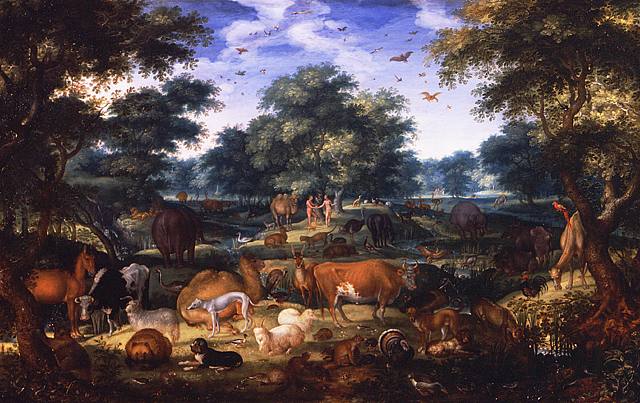
But not all belief systems see the world this way. Native American animistic belief systems (for example) see the world where all beings (not just humans) have spirits or “souls” and have equal value to humans. It is a cooperative relationship between humans and the natural world around them, with humans not retaining any more special place than any other organism.

This highlights a key difference between these two belief systems in that the Christianity adopts an "ego" view of human relationship with the natural world (control or domination) while animism assumes a "eco" relationship (cooperative, equal).

There is an impulse to ask "Which one is right?" This is a reasonable question, but that goes beyond the scope of this course.
For the purpose of this discussion, let’s step back a bit and allow information from the natural world to shed light on this topic by instead looking for parallels between humans and non-human populations. Doing so can shed more light on shared behaviors and help us understand why those behaviors exist and benefit our communities, regardless of whether we are human or not. Let's examine a specific human
behavior related to belief systems and consider whether this behavior is unique
to humans or perhaps something humans share with other organisms.
When a person dies, a driving force behind the development of burial practices and the contribution of grave goods is the process of “mourning” the loss of that individual carried out by those the dead have left behind. This thought process is often associated with a deeper cognition of “self” and, with death, the loss of that “self”. The loved one and valued member of our community is there with us one second and gone the next, leaving a sharp absence we have difficulty accepting and processing. That transition from “life” to “death” is called a “liminal state". Those the dead leave behind also go through their own “liminal state” from having that person in your life to the *absence* of that person in your life. Adjusting to that absence is what we call “mourning”, moving from shock and sadness to acceptance of their new “state” of being… along with ours.
From a cultural anthropology perspective, this liminal state of "mourning" drives the creation of cultural practices that help us navigate this transition. This could include funeral ceremonies, care for the dead (including grave goods and clothing), isolation behavior during mourning, *and* beliefs about what is happening with our loved one now that they are no longer with us. This includes the concept of an afterlife.
But is this process of mourning unique to humans?
It was once generally accepted that mourning is unique to humans. But as we pay more attention to the non-human organisms around us, this no longer seems to be the case.
Example: The Orca populations in the Pacific Northwest (and globally) have been making the news in the past few years for various reasons. Some have caught the world’s attention by wearing dead salmon on their heads like hats. Other pods of young males have become playful (and yet scary) troublemakers, harassing people in boats.
 |
| An Orca Wearing a Salmon "Hat" |
But one practice that erases the line between species and
highlights our similarities is the female orcas who have lost their babies
carrying the bodies of their dead offspring around for days or weeks, refusing
to release them to the sea. Perhaps the
most famous example occurred in 2018, when an orca mother named Tahlequah
carried her dead calf atop her head for 17 days, traveling over 1,000 miles.
Devastatingly, researchers observed her exhibiting the exact same mourning
behavior years later, carrying another deceased calf for days, calling it her “tour
of grief”.
“Tour of Grief” Orca Seen Carrying Second Dead Calf for Over 11 Days
We see the exact same difficult “liminal” state for this
Orca mother trying to adjust to the loss of her offspring as we see when a
human mother loses her child. Many of us
can empathize with her loss, as we see in her behavior the same “mourning behavior”
we would experience in the same circumstances.
Our heart breaks for her as it would for any human mother going
through the same experience.
Given this example, a question arises:
Since we see a connection between the liminal state of “mourning” and the creation of belief systems to help us manage that transition, is it possible that non-humans like Orcas might have their own “belief systems” to help them manage this liminal state? Or are humans still unique in that trait? And can you think of any other non-human practices similar to what we see in orcas that indicate the existence of the “liminal state” in other non-humans?
Respond to this question prompt below for 5 bonus pts. Make sure you back up any claims with evidence (not just “feelings”). If you wish to earn an additional 5 points pts, respond to another student offering a critical (positive or negative) response to their initial comment.


While animals don't use words to describe an afterlife, they absolutely have rituals to deal with the shock of death.
ReplyDeleteElephants: When an elephant dies, the herd will go completely silent. They gather around the body and carefully touch the bones and tusks with their trunks. It works just like a human wake.
Chimpanzees: Chimpanzee mothers have been seen carrying and grooming their dead babies for months, struggling to let go. Entire groups will also change their daily travel paths and quiet down after losing a member.
If a "belief system" means using structured, group behaviors to cope with the pain of loss, then orcas, elephants, and chimps definitely have their own versions. Mourning isn't just a human thing—it belongs to any animal smart enough to love its community.
What I feel defines a belief system is whether the ritual is only carried out by one individual and not others within their community when presented with identical circumstances. Do all chimpanzees of a certain group carry around their dead children, or is it a maladaptive response to grief? Ed Gein, a notorious american murderer, preserved his mother's corpse for years and completed other actions that were condemned. We would not say that Ed Gein's psychotic beliefs were representative of a belief system. It might be much the same in other species. Elephants, I feel, provide a much more convincing example as the behaviors that they follow are often consistent throughout a whole group. The multi-generational nature of elephant's traditions also lends credibility to the idea that they represent a belief system.
DeleteThe option that immediately comes to mind is elephants. Elephants have been observing a form of burial, covering their dead with branches and dirt. After an elephant matriarch died, other elephants were observed venturing to see her body. They have also been observed participating in other activities that seem to have similarities to human religions, such as in this quote from Elephants and Religion
ReplyDeleteby Karen Raber
"it is observed in Ethiopia that when the moon is changed until her prime and appearance, these beasts by a secret motion of nature take boughs from off the trees they feed upon and first of all lift them up to heaven and then look upon the moon, which they do many times together, as it were in supplication to her."
Of course, this might just be projection of the humans. Elephants might do this for a purpose that we just don't understand. Like with the stories told of horses who can do math and pigs that can read minds, it might simply be a trick or an unexpressed desire of the human mind to see similarities between us and other creatures.
Hi Joyce, I really like how you mentioned that there is definitely a chance that other species other than humans could bury their dead for religious or spiritual reasons. I love that you compared it to elephants because I really do think that they have the most similar grieving practices to humans which is a great way to really think about if it could be possible.
DeleteHi Joyce, I did not know that elephants participated in the action of taking leaves and lifting them to the moon. I think that example is incredibly insightful and I can understand why many belief that to be a sign of religion or a belief system among elephants. Through this, I became curious and did a bit of research on this act. While this was described in literature during the Renaissance, modern zoologists have observed that, although elephants are intelligent creatures and pose signs of mourning, they have not recently been reported to have ritualistic/worshipping behaviors towards the moon. I do agree with you that human nature to project feelings onto inanimate objects or other animals blurs the idea of whether or not other animals create belief systems or not.
DeleteThis example with the orca mother (like Tahlequah) really challenges the idea that mourning is something only humans experience. Her behavior, carrying her dead calf for days and refusing to let go, shows a clear response to loss that looks very similar to human grieving. From a biological and behavior standpoint, scientists have observed that mainly highly social animals especially those with strong family bonds and large brains, display reactions to death that suggest awareness and emotional processing. In orcas, researchers have documented repeated instances of mothers carrying deceased calves, along with changes in vocalizations and groups behavior, which supports the idea that this is not random but meaningful behavior tied to loss. However, saying that orcas (or other animals) have "beliefs systems" like humans is harder to prove. Belief systems usually involve symbolic thinking, shared meanings, and explanations about life, death, or an afterlife; things that are difficult to measure in non-human animals. While orcas clearly experience something like a liminal state of mourning, there is no concrete evidence that they create symbolic explanations or structured beliefs aspects of mourning, humans may still be unique in turning those experiences into complex belief systems and cultural practices. There are also other examples in the animal world that support the idea that mourning is not unique to humans. Elephants, for example, have been Widely observed interacting with the bones of deceased herd members, touching and revisiting them over time. Chimpanzees have been seen staying with dead group members, growing them, or showing signs of distress and withdrawal. These behaviors suggest that the liminal state; adjusting to the a sense of a group member, is something shared across species. Overall, the evidence shows that while humans may be unique in developing detailed belief systems, the emotional foundation of mourning and the experience of loss is something we share with other animals.
ReplyDeleteI really like how you mentioned how the way that orca’s respond to death really does make it seem like they might have their own belief system. It’s something I never really thought of before reading this. I always just assumed that it was for a mourning Practice rather than a spiritual one, but I feel like after reading more about it definitely seems like there is a high probability that it is for their own spiritual reason
DeleteHi! I really appreciated your point about how belief systems require symbolic thinking and shared abstract meanings, which are hard to measure in non-human animals without language.
DeleteWhile I agree that we can't definitively prove animals hold beliefs about an afterlife, do you think it's possible that structured, repeated grieving behaviors (like elephants returning to bone sites seasonally) function as the early evolutionary foundation of what eventually became human ritual and religion?
Although it can’t be proven, there’s definitely enough evidence to back up the theory that animals do, in fact, mourn. Some studies have been done on animals, such as orcas, elephants, and dolphins, all of which have shown different and unique signs of mourning. Even though evidence does show that animals do seem to mourn, humans are still different than any other species when mourning. While some animals do bury their dead, the reasoning behind it is much different than that of humans. Although in the beginning humans buried their dead for practical reasons, over time burial became associated with religious purposes. This is what makes animals so different from humans in the grieving process. Although it cannot be proven, it is definitely possible that animals have their own belief systems based on their grieving process.
ReplyDeleteI think there’s a lot of evidence that animals can grieve, especially in the case of species like orcas and elephants. I also like your point about how humans have developed more symbolic and religious practices around death over time, which makes our grieving process different. It’s possible animals have their own belief systems. But I think we’d need more evidence before we jump to that conclusion. Their behaviors clearly show emotional attachment and grief, but it is still difficult to know if they understand death in the same symbolic way that we do.
DeleteGiven that similar behaviors that replicate mourning are seen in several non-human species aside from the orca, I believe that there is decent amount of evidence that can support the idea that animals mourn and foster beliefs to manage grief and the liminal state. It has been reported that Asian elephants express similar actions of mourning and will even bury their dead and even avoid burial sites when mapping migration routes (Court House News Service). Additionally, other animals, such as chimpanzees and crows, exhibit signs of mourning. Chimpanzees behave similarly to orcas and carry their deceased infants for weeks while grooming and protecting their bodies. Crows will alert its murder to a dead companion and funeral service of sorts is held where all of the crows surround the dead. What all of these animals have in common is that they have been known to be extremely social animals. These animals do not just build large communities within their own flocks/herds, but they have been known to become curious and interact with human nature as well. Knowing that humans are also extremely social and that we have created several forms of belief systems to deal with mourning and the passing of the liminal state, there could be a parallel between how social and connected a species is to their community and how they process death within that community, ultimately forming a belief system. Although humans tend to anthropomorphize objects or other animals and try to relate to their own experiences to others, the way each of these species has a unique way in dealing with mourning can suggest the idea of belief systems within other species. Ultimately, we can never truly be sure due to the fact that we cannot truly decipher the emotions and complexities of other animals.
ReplyDeleteHi Krystel! I completely agree that high social connectivity bridges the gap between animal mourning and human ritual, though we still have to be careful not to fully project our own complex belief systems onto them.
DeleteI think it's possible that some animals have maybe the beginnings of belief systems, but there isn't enough real, solid evidence to say whether they actually have religions or spiritual beliefs like the way that humans do. Tahlequah carrying her dead calves for days shows that orcas can feel grief and struggle with losing someone close to them, just like people do. However, this doesn't point towards religion or spirituality as it is more so about emotions and grief. Similarly, humans who or atheists still feel grief and mourning even if they aren't religious. However, just because we have no proof of religious or spiritual beliefs among other species, doesn't mean that they don't exist. We simply have no knowledge of knowing for sure either way. This liminal state of mourning has also been seen in other animals. For example, elephants have been seen touching the bones or bodies of dead elephants with their trunks and then proceeding to return to those places later, typically seasonally. This shows that mourning is not something only humans experience.
ReplyDeleteHi Shanthi,
ReplyDeleteI really appreciated your distinction between emotional grief and spiritual belief, especially your example of how atheists experience grief without relying on religious frameworks! That makes a lot of sense.
From an anthropological perspective, do you think it's possible that recurring, shared mourning behaviors—like elephants seasonally revisiting bone sites—serve as the early evolutionary foundation for what eventually becomes ritualized belief, or do you think emotional processing and symbolic ritual should be viewed as two completely separate categories?
I don't think mourning is something that only humans experience. There is evidence that some animals may also grieve or react to death in ways that are similar to humans. One example is Tahlequah, an orca mother who carried her dead calf for 17 days and traveled over 1,000 miles. Researchers later saw here carry another dead calf for several days. This makes it seem like she was having a difficult time letting go of her babies, similar to how a human parent might react to losing a child.
ReplyDeleteThere are also examples of other animals showing similar behaviors. Elephants have been seen staying near the bodies or bones of other elephants and touching or investigating them. Chimpanzees have also been observed carrying dead infants for long periods of time. These examples suggest that some animals may understand that something has changed when another member of their group dies.
However, I don't think we can know for sure if animals have belief systems like humans do. Humans use language and culture to create funeral traditions, religions, and ideas about the afterlife.Since we cannot directly ask animals what they believe, it is difficult to know exactly what they are thinking.
Still, I think the evidence shows that humans may not be the only animals capable of mourning. Animals like orcas, elephants, and chimpanzees show behaviors that could be signs of grief. They may not have organized religions or funerals like humans, but that does not necessarily mean they do not experience some kind of mourning or loss.
Overall, I think mourning may be something that humans share with some other animals. What might be unique to humans is the way we create complex belief systems and traditions to help us understand death.
Hi Denise! I really like how they draw that clear line between emotional mourning, which is definitely shared, and human symbolic culture, which we still can't prove exists in other species.
DeleteI believe the evidence indicates that humans are not the only species that grieves, even if we can’t be sure that other animals have belief systems like ours. Strong emotional attachment and difficulty letting go (example: the orca Tahlequah carried her dead calf for days) Researchers have also watched elephants go back to the bones of dead herd members and touch the bones gently with their trunks. Chimpanzees have been observed lingering with dead infants and exhibiting signs of distress when losing close companions. These behaviors indicate that many social animals go through a liminal period of adjustment to the loss of a member of their group. But, the fact that non-human animals mourn alone is not sufficient evidence to suggest they have belief systems or concepts of an afterlife. Human belief systems also include symbolic thought, shared traditions, rituals and language that are difficult to demonstrate in other species. Grief appears to be common to many intelligent social animals . However , organized belief systems are a uniquely human trait .
ReplyDeleteHi! I strongly agree with you. I feel like every creature on earth has their own feelings and emotions and they get past them in their own ways, just how humans do things differently in their own cultures or traditions. What I also liked is how you mentioned how "religion" or organized belief systems are completely a human trait.
DeleteThis week's prompt does a great job showing how we often think humans are completely unique (the "ego" view), but nature proves we are actually deeply connected to other species (the "eco" view). When we lose someone, we go through a confusing transition phase a "liminal state" where we have to figure out how to live without them. For humans, this deep grief is exactly what led us to create funerals, burial rituals, and belief systems about the afterlife to help us cope.
ReplyDeleteWhile we can't know for sure if animals like orcas have actual "religions" or ideas about heaven, they absolutely experience the exact same heartbreaking grief that we do. For example, just like the tragic story of the mother orca carrying her dead calf, African elephants are known to return to the bones of their dead family members to gently touch them and mourn. Even if they don't have a formal belief system, the emotional pain of losing a loved one and needing time to process it clearly isn't just a human trait.
We can also see other animals dealing with this "liminal" transition in how they rely on their communities after a sudden loss. When an orca pod loses a family member, they often work together to physically support the body at the surface of the water for days. Just like a human wake or funeral, this gives the whole animal family a communal pause to process the shock, grieve, and adjust to their new reality together.
I don't think humans are the only ones that mourn. The story about Tahlequah carrying her dead baby for days shows that orcas feel sadness, grief, and understand death too. I don't think this means animals have religions like people do, but I do think that they have their own ways of dealing with grief. I think humans and animals have more in common than we sometimes realize when it comes to losing someone they care about. I believe every creature on earth has their own feeling and emotions we are just taught by society that “humans” only feel. Although animals can’t speak or have a voice for themselves, I believe they grieve and feel the same emotions we do, just in their own way.
ReplyDelete